Framed as a Choice: Degree or Skills
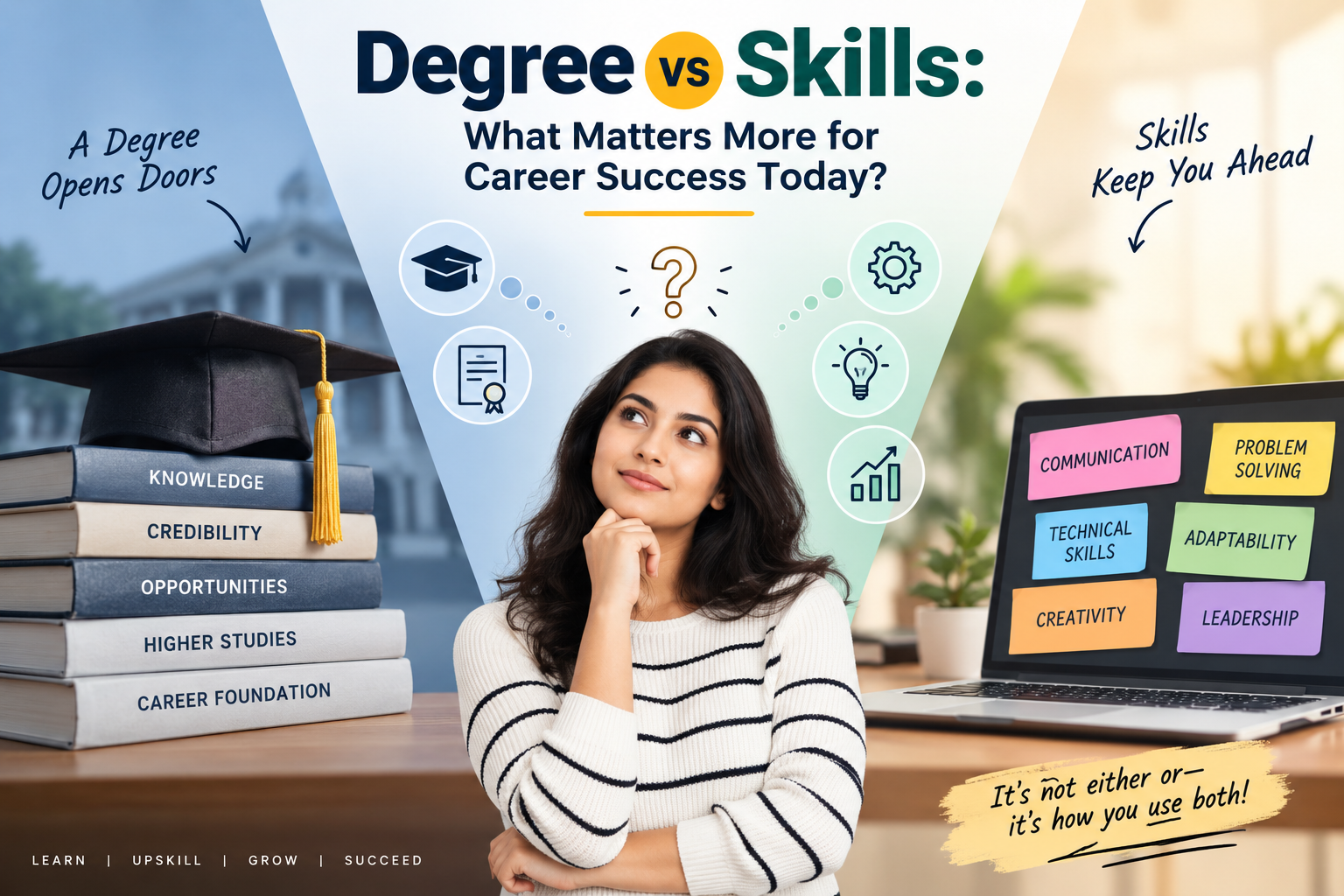
Presented as degree or skills, the framing itself is misleading for most careers, since the two serve different functions — one opens doors, the other determines how well a person performs once inside them.
What degree still buys? The importance of a degree persists in a few specific ways: it remains a hard eligibility requirement for government jobs, regulated professions and most master's programmes; it signals sustained commitment to structured learning; and it typically provides theoretical grounding that ad hoc skill-building rarely covers as thoroughly.
What skills alone can't replace, and what they can? The importance of skills shows up differently — in faster hands-on productivity from day one, in adaptability when a role's requirements shift, and in evidence that can be demonstrated directly through a portfolio or project rather than inferred from a transcript.
The Skills That Actually Move a Career
Regardless of field, certain career skills show up consistently in what moves people forward:
- Clear written and verbal communication
- Structured problem-solving under ambiguity
- Basic digital and data literacy
- Collaboration across teams and functions
- Adaptability when priorities or tools change
Skills Recruiters Quietly Screen For
Beyond the job description, employability skills that recruiters quietly weigh include reliability, the ability to take feedback constructively, and evidence of initiative beyond assigned coursework.
Building job-ready skills during a degree — through internships, apprenticeships or independent projects — closes much of the gap between graduating and actually performing well in a first role.
Why Degree and Skills Work Better Together Than Apart
The strongest position is neither pole — it is treating degree and skills as complementary layers, where the degree provides credibility and foundational knowledge, and skills provide the applied evidence that knowledge can actually be used.
Concrete skills worth building during a degree include:
- A portfolio of real projects, even small ones, relevant to the target field
- Comfort with common workplace tools and software
- Written communication practised through reports, essays or blog posts
- At least one internship or apprenticeship placement before graduation
When asked directly, hiring managers describe skills employers look for as a mix of technical competence for the role, reliable communication, and the ability to learn new tools quickly rather than needing every skill already mastered.
Career Readiness Is Broader Than Either Alone
Genuine career readiness draws on both the credibility a degree provides and the applied evidence skills provide — neither factor alone consistently predicts strong early-career performance.
Certain sectors keep college degrees as a hard requirement regardless of demonstrated skill — government service, regulated professions such as law and medicine, and most eligibility criteria for further postgraduate study.
Skills That Compound Over Time
Distinct from technical ability, professional skills — time management, workplace communication and reliability — compound steadily over a career and often matter more to long-term progression than any single technical skill learned early on.
More than any specific competency, learning skills — the ability to pick up new tools, frameworks and knowledge efficiently — tend to matter most over a full career, since the specific skills in demand keep changing well after graduation.
Weighing It Side by Side: The Anchor and Edge Model
A degree functions as an anchor — it provides stability, credibility and eligibility that rarely expire. Skills function as an edge — they provide differentiation, adaptability and speed that a credential alone cannot demonstrate. Neither works as well without the other: an anchor with no edge struggles to stand out, and an edge with no anchor can struggle to clear basic eligibility filters in many sectors.
Degree vs Skills: A Side-by-Side View
| Aspect | Degree | Skills |
|---|---|---|
| What it signals | Sustained, structured learning and eligibility | Applied, demonstrable capability |
| How it's proven | Transcript and credential | Portfolio, project or work sample |
| Where it matters most | Government, regulated professions, further study | Fast-moving industries, startups, creative and technical roles |
| Shelf life | Long, largely stable | Requires continuous updating |
| Best combined with | Applied skills and internships | A credential for eligibility and credibility |
👉 Looking for a route that builds both credential and applied skill at once? Explore Arka Jain University's distance programmes to see how the two are combined.
Settling the "Which Is More Important" Debate
Asked directly as degree vs skill which is more important, the honest answer depends on the sector — regulated and government-facing careers weight the degree more heavily, while fast-moving industries and creative or technical roles weight demonstrated skill more heavily, though both remain useful in nearly every case.
The argument for why skills matter more than degrees holds up best for speed-to-productivity and career pivots, where a portfolio can prove capability faster than a transcript — but it does not eliminate the degree's continued role in eligibility, credibility and long-term progression.
Neither Side Wins Alone
The more useful question was never which one matters more in the abstract, but how a degree and a set of demonstrated skills are combined for a specific career path. Students who build both deliberately tend to outperform those who lean entirely on either one.