
Build a Selection Guide Before Visiting a Single Campus
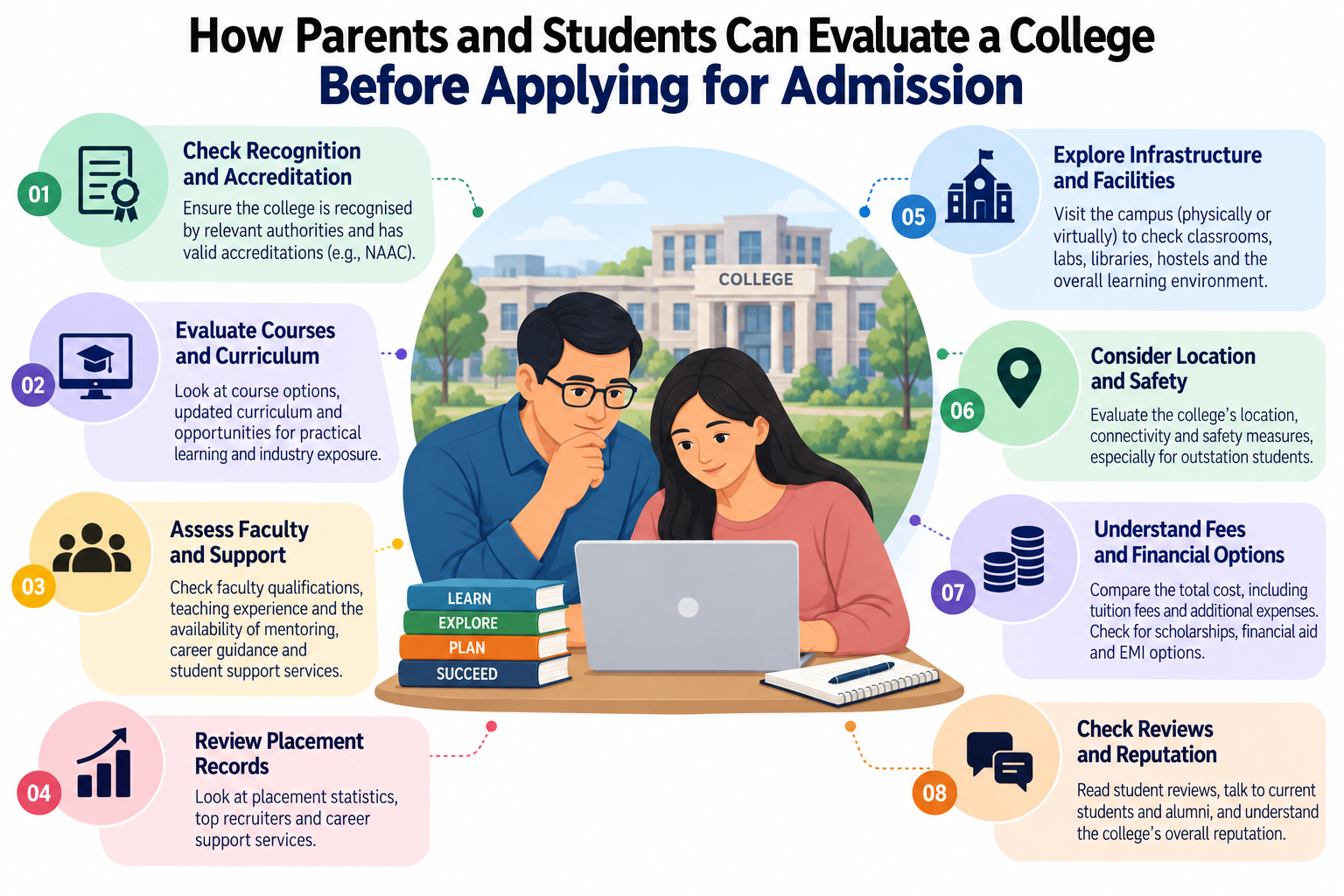
A working college selection guide is simply a short list of non-negotiables — accreditation, faculty credentials, placement record, fee transparency and format — checked before any campus visit or counsellor conversation begins.
Practically, how to choose a college comes down to a short sequence:
- Confirm official recognition and accreditation status
- Check faculty qualifications for the specific programme
- Review placement or further-study outcomes, not just headline numbers
- Compare total cost, including fees not listed upfront
- Assess flexibility of format if online or blended study is being considered
Recognise the Real Factors for Choosing a College
Beyond the checklist above, the factors for choosing a college that consistently separate a strong choice from a weak one include curriculum relevance to career goals, student support infrastructure, and how transparently the institution communicates fees and policies.
A more useful mindset for choosing a college treats it as an evidence-based comparison rather than a brand decision — the same discipline applied to comparing any major purchase, where claims are verified rather than assumed.
Use an Admission Guide, Not Word of Mouth Alone
A reliable college admission guide relies on official prospectuses, UGC or regulatory listings, and direct communication with the institution — not hearsay from acquaintances whose circumstances may differ significantly from the applicant's own.
A proper college comparison is easiest done on a fixed set of categories rather than an open-ended impression, covering fees, faculty-to-student ratio, accreditation status, placement record and delivery format across every shortlisted option.
Confirm University Status Early
As part of basic university selection literacy, it is worth understanding that terms like university, deemed university and autonomous college carry different regulatory meanings, which affects degree recognition and should be confirmed before assuming any two institutions are equivalent.
Specific things to check before college admission should include:
- Refund and cancellation policy in writing
- Hostel and campus facilities, if relevant
- An active placement or career support cell
- Current validity of accreditation, not an outdated claim
- Verified faculty credentials for the specific department
Get to a Short List
Narrowing down choosing the right university to a short list works best once the checks above have already filtered out institutions that failed a basic transparency or recognition test.
Four pillars capture most of what matters. Recognition checks official accreditation and university status. Faculty checks qualification and availability of teaching staff for the specific programme. Outcomes checks placement, further-study and student progression records. Support checks the presence of mentoring, grievance redressal and career guidance infrastructure. An institution weak on even one pillar deserves a direct question before it stays on the shortlist.
What to Check, and What It Signals
| What to check | Why it matters | Red flag to watch for |
|---|---|---|
| Accreditation status | Confirms independently verified quality | Outdated or unverifiable claims |
| Faculty credentials | Determines actual teaching quality | Vague or unnamed faculty listings |
| Fee structure | Prevents hidden cost surprises later | Reluctance to share full cost breakdown |
| Placement record | Indicates real student outcomes | Aggregate numbers with no programme-level detail |
👉 Ready to see how a structured, apprenticeship-linked programme holds up against this checklist? Explore undergraduate programmes at Arka Jain University and apply the same evaluation directly.
Turn It Into an Admission Checklist
Reduced to a final, actionable college admission checklist:
- Recognition and accreditation verified directly with the official body
- Faculty credentials confirmed for the intended department
- Full fee structure, including hidden costs, obtained in writing
- Placement or outcome data reviewed at the programme level
- Refund and grievance policies read before signing anything
👉 Comparing a specific institution against this checklist? Visit Arka Jain University's official site to verify these details directly before deciding.
The right college is rarely the one with the loudest marketing — it is the one that holds up when its claims are checked directly. A short, consistent checklist applied to every shortlisted option removes most of the guesswork from what otherwise feels like an overwhelming decision.