
Foundation for Business Careers
Undergraduate management education exists for a reason. Before learners specialise in finance, marketing, operations, or entrepreneurship, they must understand how organisations function as integrated systems.
A BBA course is designed to introduce learners to the logic of business early in their academic journey. Instead of treating business as a collection of independent functions, BBA frames it as a decision-driven environment where strategy, people, processes, and markets constantly interact.
The BBA course duration, typically structured over three years, allows this thinking to develop gradually. Concepts are revisited at increasing levels of complexity, enabling learners to move from understanding definitions to applying reasoning. This time-based progression is crucial—managerial thinking cannot be rushed or compressed without losing depth.
More importantly, BBA serves as a foundation rather than a finish line. It equips learners with the mental models required to grow into managerial roles over time, across industries and organisational scales.
How BBA Builds Business Thinking
Business thinking is not instinctive; it is learned. The value of management education lies in making implicit reasoning explicit—teaching learners how to think before asking them what to do.
Developing Business Thinking Skills
The business thinking skills in distance BBA programmes are shaped through exposure to realistic business scenarios rather than abstract theory alone. Learners are trained to:
- View problems from multiple stakeholder perspectives
- Recognise trade-offs rather than search for perfect solutions
- Understand how constraints shape decisions
This approach encourages learners to move beyond binary thinking and develop comfort with ambiguity—an essential managerial trait.
Analytical Reasoning in the Curriculum
A core component of this development is analytical thinking in BBA curriculum. Students are taught to:
- Break complex business problems into manageable components
- Interpret qualitative and quantitative information
- Identify patterns and implications rather than isolated facts
These analytical habits form the backbone of managerial judgement, allowing future managers to respond thoughtfully rather than reactively.
Reasoning Skills Over Memorisation
Unlike purely academic disciplines, management education emphasises reasoning over recall. The business reasoning skills in BBA students emerge as learners repeatedly engage with case-based discussions, applied assignments, and scenario analysis. Over time, this trains the mind to evaluate situations contextually—a defining feature of managerial competence.
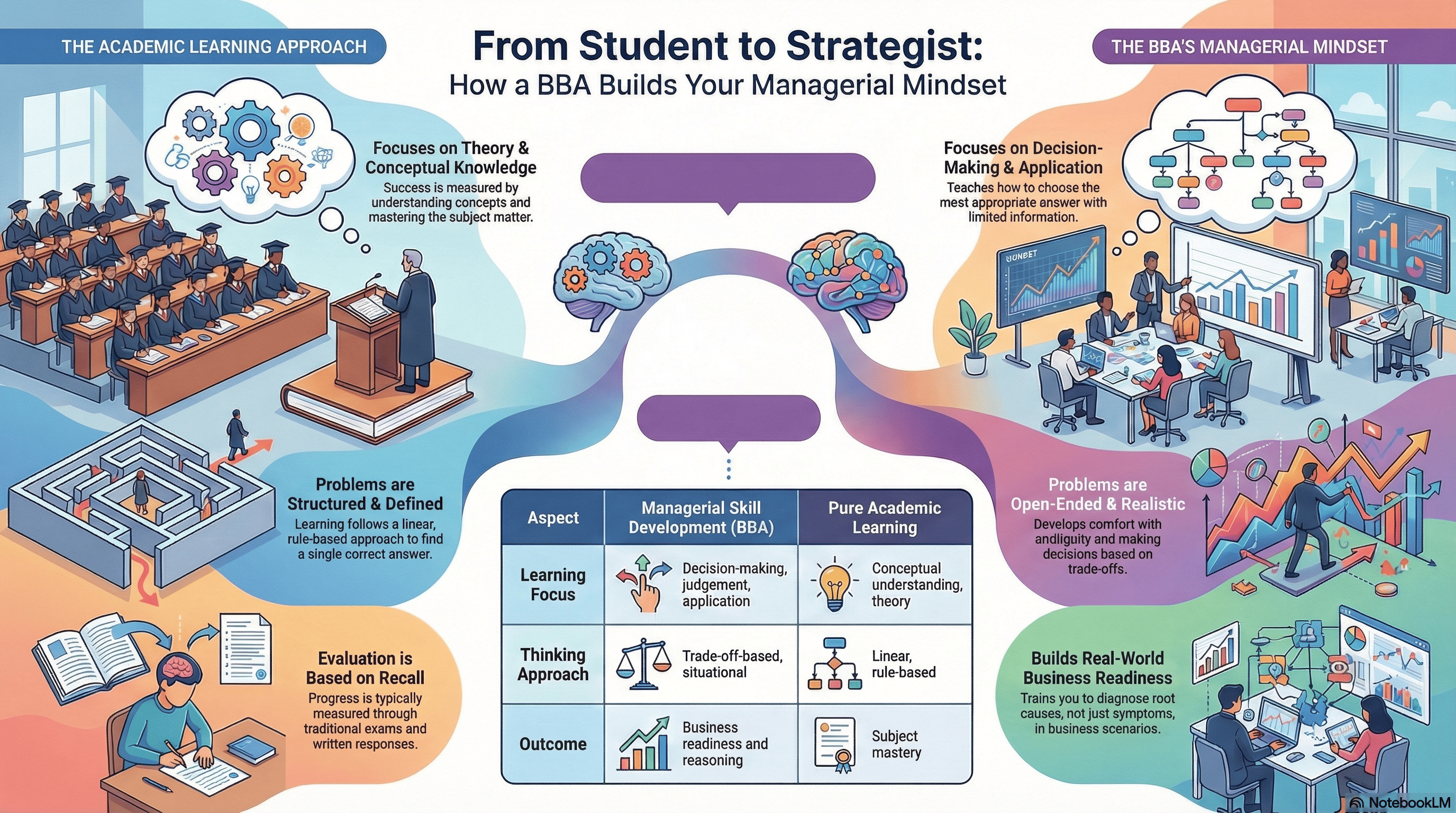
Managerial Mindset vs Pure Academic Learning
One of the most important distinctions in undergraduate education is the difference between academic knowledge acquisition and managerial mindset development.
How BBA Develops a Managerial Mindset
The question of how BBA develops managerial mindset is best answered by examining its learning orientation. Management education is not about mastering one correct answer; it is about choosing the most appropriate answer given limited information, competing priorities, and human factors.
This mindset contrasts sharply with disciplines where learning outcomes are measured primarily through theoretical accuracy.
| Aspect | Managerial Skill Development in BBA | Pure Academic Learning |
|---|---|---|
| Learning Focus | Decision-making, judgement, application | Conceptual understanding, theory |
| Problem Nature | Open-ended, context-dependent | Defined, structured |
| Evaluation Style | Case analysis, applied assignments | Exams, written responses |
| Thinking Approach | Trade-off-based, situational | Linear, rule-based |
| Outcome | Business readiness and reasoning | Subject mastery |
This comparison highlights why BBA graduates often adapt more quickly to organisational environments—they are trained to think in terms of impact and feasibility, not just correctness.
Understanding Organisations as Living Systems
Another critical outcome is understanding organisations through BBA. Learners begin to see organisations not as charts or departments, but as dynamic systems shaped by people, incentives, culture, and external pressures. This systemic understanding is essential for anyone aspiring to managerial responsibility.
Strategic and Decision-Making Capability
Strategic thinking is often mistaken for senior-level planning. In reality, strategic capability begins with how individuals assess situations and anticipate consequences.
Strategic Thinking in Management Education
The strategic thinking taught in BBA programs focuses on:
- Long-term implications of short-term decisions
- Alignment between goals, resources, and execution
- Competitive positioning and value creation
Learners are encouraged to look beyond immediate outcomes and consider sustainability, scalability, and organisational fit.
Decision-Making as a Learned Skill
Equally important are the decision-making skills. Through repeated exposure to business dilemmas, students learn that:
- Decisions often involve incomplete information
- Timing matters as much as accuracy
- Accountability is integral to managerial roles
These lessons shape judgement—arguably the most valuable managerial asset.
Leadership and Real-World Readiness
Leadership is not limited to authority; it begins with influence, responsibility, and problem ownership.
Leadership Skills in distance BBA
The programs emerge through collaborative learning, group assignments, and applied projects. Learners practice:
- Communicating ideas clearly
- Negotiating viewpoints
- Taking initiative within constraints
These experiences simulate organisational realities where leadership is exercised without formal power.
Problem-Solving in Business Contexts
A defining feature of management education is its emphasis on applied problem-solving. The program trains learners to:
- Diagnose root causes rather than symptoms
- Balance analytical rigour with practical constraints
- Implement solutions within real-world limitations
Over time, this approach shapes confidence and decisiveness.
Shaping Business Judgement
Ultimately, how BBA shapes business judgement lies in repeated exposure to consequence-driven thinking. Learners begin to ask not just what is correct, but what will work—a shift that marks the transition from student to professional thinker.
distance BBA in the Indian Context
India’s business landscape presents unique managerial challenges—diverse markets, regulatory complexity, rapid growth, and resource constraints. Undergraduate management education must therefore be both conceptually strong and contextually relevant.
An distance BBA degree in India responds to this reality by enabling learners from varied backgrounds to access structured management education without disrupting their geographic or economic circumstances. distance delivery, when academically rigorous, supports continuity rather than compromise.
Institutional Context and Fee Accessibility
Within this landscape, universities offering distance and distance management education play a critical role in widening access. Institutions such as Arka Jain University have contributed to this ecosystem by offering structured undergraduate management programmes through distance education frameworks.
From an affordability perspective, Arka Jain BBA fees—with a total programme cost of ₹55,500—position the degree as an accessible academic investment rather than an exclusive credential. This affordability aligns with the broader goal of expanding managerial education across socio-economic segments.
The BBA course details in such contexts emphasise foundational management learning rather than premature specialisation, reinforcing the degree’s role as a base for long-term growth.
Thinking Like a Manager Before Becoming One
Managerial thinking cannot be switched on with a job title. It is shaped through years of exposure to decision-making frameworks, organisational logic, and applied reasoning. Online BBA does not promise instant leadership—but it does something far more valuable.
It teaches learners how to think in business terms before they are asked to act as managers.
For those who view management as a long-term responsibility rather than a short-term ambition, this program remains a strong, scalable foundation—one that prepares the mind before preparing the résumé.