
Where the Bigger Paychecks Actually Are
Among these, high paying jobs after BBA tend to cluster around roles that combine business judgement with a hard-to-replicate technical or analytical skill investment and financial analysis; business analytics, product management, and fintech-adjacent roles consistently sit above average across most sectors.
Alongside these established options, several genuinely emerging careers for BBA students are opening up around sustainability reporting, digital transformation consulting, and AI-integration roles inside traditional business functions, where a management graduate who also understands the underlying technology is unusually valuable.
Reading the Long-Term Signal
Looking further out, the clearest signal about future careers in business is that the line between 'business' roles and 'technical' roles is steadily blurring, with employers increasingly hiring for the combination rather than treating them as separate hiring tracks.
None of this makes the traditional route obsolete. Core business management careers general management trainee programmes, operations leadership, and cross-functional rotational roles remain a reliable, well-trodden path into senior leadership over time, particularly at larger, established organisations.
One of the fastest-growing segments within this space is built around interpretation rather than production of data. Careers in business analytics now span marketing analytics, financial analytics, supply chain analytics, and customer insights, all of which reward a BBA graduate who can translate numbers into a business decision rather than simply generate a report.
The Financial Sector's New Shape
Financial services have arguably changed the most. Careers in fintech now cover digital payments, lending platforms, wealth-tech, and regulatory technology, with hiring driven as much by product and growth thinking as by traditional finance knowledge.
None of these paths opens up automatically from a transcript alone. Core business skills for BBA students structured problem-solving, financial literacy, negotiation, and clear written and verbal communication remain the foundation every one of these career tracks is built on top of.
The Skill Layer Most Students Still Skip
Layered on top of that foundation, AI skills for business students have moved from optional to close to essential, since even non-technical business roles now routinely involve directing AI tools for research, analysis, and first-draft content rather than avoiding them.
Who's Actually Doing the Hiring
Understanding which industries hiring BBA graduates are expanding fastest helps focus preparation. Technology-enabled financial services, e-commerce and D2C brands, consulting, healthcare-adjacent business functions, and logistics have all shown consistent, broad-based hiring for business graduates in recent hiring cycles.
The first role is rarely the end of the story. Sustained career growth after BBA tends to follow one of two patterns: deepening expertise within a single function toward a specialist leadership role, or broadening across functions toward general management. Deciding which pattern to pursue early makes each subsequent career move considerably easier to plan.
A Step-by-Step Roadmap for Getting There
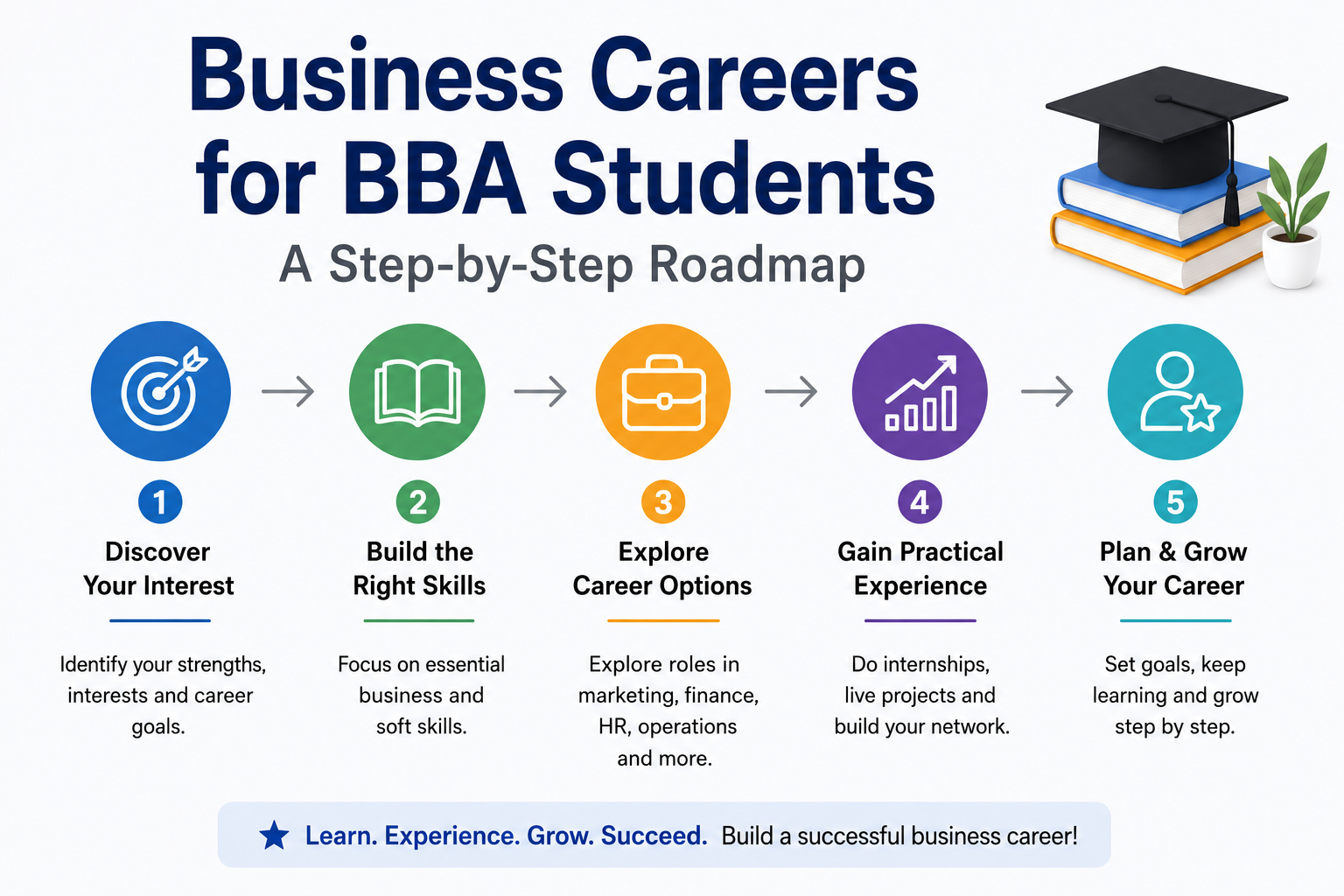
Rather than treating career planning as a single decision made at graduation, it works better as a five-step sequence, revisited and adjusted throughout the degree rather than left until the final semester.
- Step One: Explore: Spend the early part of the degree deliberately sampling different functions through electives, projects, or short exposure programmes rather than assuming an interest without testing it.
- Step Two: Specialise: Once a genuine area of interest emerges, choose electives and coursework that build depth in that direction, while keeping enough breadth to pivot if the interest shifts.
- Step Three: Build the Skill Layer: Deliberately add the skills that sit outside standard coursework data tools, AI fluency, and applied analytics since these increasingly separate strong candidates from average ones.
- Step Four: Gain Real Experience: Seek out internships and project work that mirror the target role as closely as possible, since demonstrated experience consistently outweighs coursework alone in hiring decisions.
- Step Five: Enter and Adjust: Treat the first job as a continuation of the exploration phase rather than a final destination, staying open to a specialist or generalist path as real experience clarifies which suits better.
Benefits of Following a Structured Roadmap
- Reduces the risk of drifting into a role by default rather than by choice
- Builds a coherent, explainable career story for interviews and applications
- Creates natural checkpoints to reassess direction before too much time is invested
- Makes skill-building deliberate rather than reactive
- More time to test genuine interest before committing to a specialisation
- Stronger internship applications, backed by a clearer sense of direction
- Earlier exposure to skills, like AI tools and analytics, that take time to build genuine fluency in
- A meaningfully stronger position when competing for high-demand entry-level roles
Trends Worth Tracking Through the Degree
- Rising demand for hybrid business-technology roles across nearly every sector
- Continued expansion of fintech and digital financial services hiring
- Growing weight placed on demonstrated analytics and AI fluency in entry-level hiring
- Increasing employer interest in sustainability and ESG-adjacent business functions
- Entry-level business hiring is more competitive, rewarding clear direction over generalist applications
- Skills gaps in AI and analytics are becoming harder to close later in a career
- A first role increasingly shapes access to faster-growing, better-compensated tracks
- Employers are visibly rewarding demonstrated initiative over degree pedigree alone
Roles Commonly Open to Business Graduates
Depending on the direction chosen, BBA graduates commonly move into roles such as:
- Business Analyst
- Financial Analyst
- Marketing Manager
- Operations Manager
- Human Resources Manager
- Business Development Executive
- Product Manager
- Fintech Associate
- Supply Chain Analyst
- Management Trainee
- Investment Analyst
Two Broad Tracks, Compared
| Factor | Traditional Corporate Management Track | Fintech / Emerging Business Track |
|---|---|---|
| Entry speed | Structured graduate programmes, often slower to start | Faster entry for candidates with demonstrable analytical or tech skills |
| Skill emphasis | Broad management fundamentals, process, and people skills | Data fluency, product thinking, and comfort with fast-changing tools |
| Growth pattern | Gradual, hierarchy-based progression | Faster, often tied directly to individual impact and initiative |
| Risk and stability | More predictable, established structures and job security | Higher variability, but often higher upside for strong performers |
| Best suited for | Those who value structure and long-term institutional growth | Those comfortable with ambiguity and rapid change |
Bringing the Roadmap Together
A BBA degree keeps a genuinely wide set of business careers accessible, but that width can turn into indecision without a structured way to navigate it. Moving deliberately through exploration, specialisation, skill-building, real experience, and finally entry, rather than waiting for a single graduation-day decision, is what turns a broad degree into a specific, well-prepared career direction.