Difference between a Distance MBA and a Regular MBA
At the surface level, both formats award the same qualification—an MBA. Yet, the way learning is experienced, internalised, and applied varies significantly.
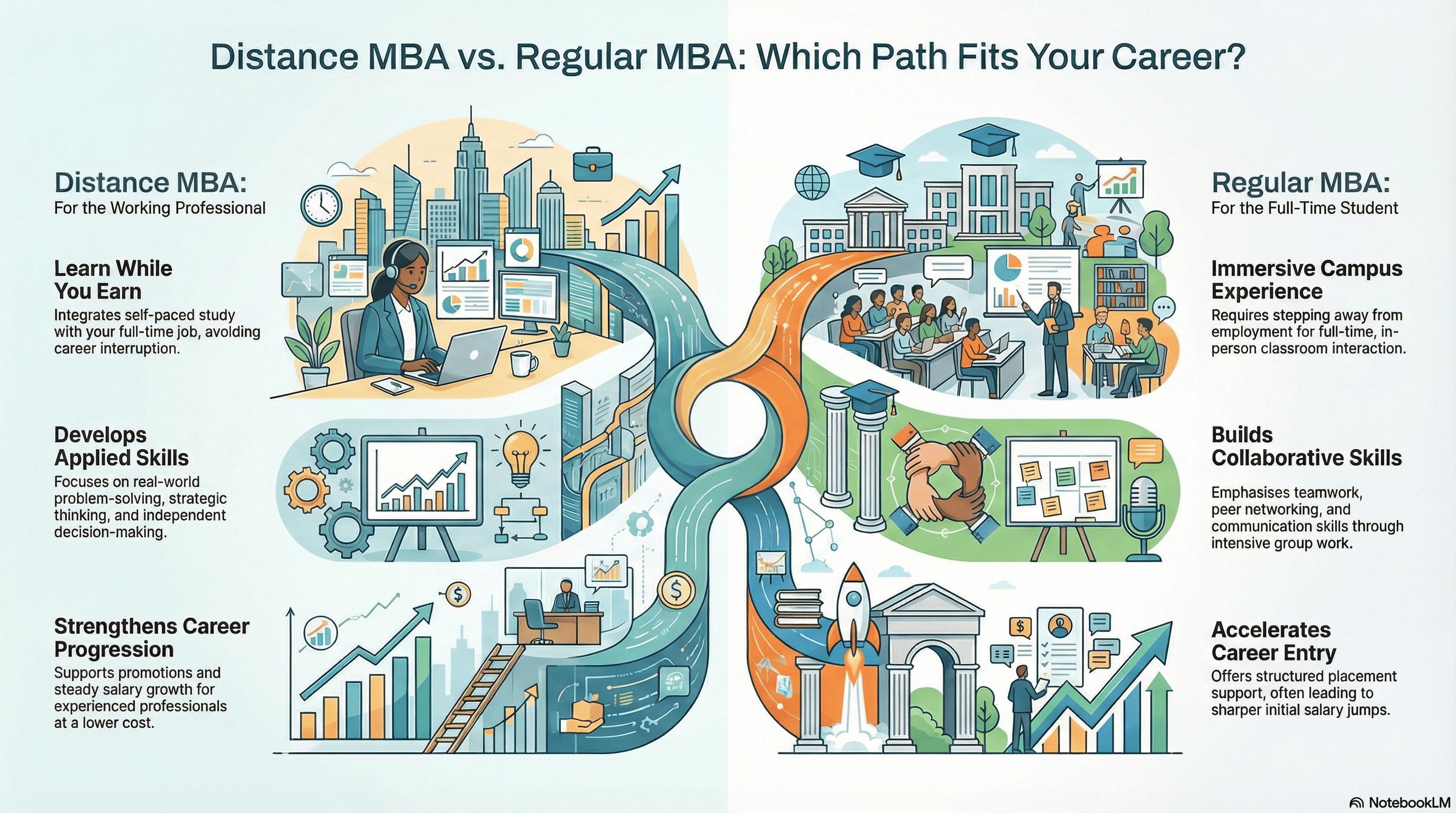
A regular MBA evolved in a time when learners could step away from employment, relocate to campuses, and immerse themselves fully in academic life. Distance and online MBAs, on the other hand, emerged as higher education adapted to working professionals, adult learners, and mid-career progression.
This is why the question of how distance MBA differs from regular MBA cannot be answered by looking at syllabi alone. The difference lies in who the learner is, what stage they are at, and how learning fits into their professional reality.
Academic Structure and Learning Experience
The learning experience in distance MBA programmes is built around autonomy, reflection, and continuity. Learners typically study alongside full-time employment, which changes how knowledge is absorbed and applied.
Distance MBA Emphasis
Instead of daily classroom interaction, distance MBAs emphasise:
- Structured modules released over time
- Self-paced engagement with academic content
- Periodic assessments rather than continuous attendance
- Application of concepts within real workplace contexts
This model is particularly effective for professionals who already operate in organisational environments and can immediately relate theory to practice.
Teaching Methodology
The teaching methods in distance MBA programmes are intentionally different from classroom instruction. Rather than replicating lectures online, they are designed to:
- Break content into focused learning units
- Encourage repeat learning and reflection
- Use assignments to test the application, not recall
- Evaluate understanding through outcomes, not participation
Academic Outcomes
As a result, the distance MBA academic outcomes often emphasise conceptual clarity, structured reasoning, and long-term retention. When executed rigorously, the outcomes of online MBA programs include:
- Strong decision-making frameworks
- Improved business judgement
- Strategic thinking grounded in professional reality
- Enhanced managerial confidence
These outcomes may develop more gradually than in immersive formats, but they tend to be deeply internalised.
Skill Development: What Learners Actually Gain
One of the most persistent myths in management education is that skill development is uniform across formats. In reality, skills learned through any mode of MBA differ in emphasis, not quality.
Skills Learned in Distance MBA
Distance MBA learners often develop:
- Independent decision-making ability
- Time and priority management
- Strategic thinking rooted in real constraints
- Applied problem-solving skills
Because learners remain embedded in professional environments, skill development is continuous rather than simulated.
Skills Learned in a Regular MBA
Regular MBA programmes tend to emphasise:
- Team leadership through intensive group work
- Communication and presentation skills
- Networking and peer-driven learning
- Exposure to competitive academic environments
Both formats develop managerial capability—but through different experiential pathways.
Career and Professional Outcomes
Today’s MBA careers are no longer linear. Professionals move across roles, functions, and even industries over time. In this context, the value of an MBA lies less in immediate placement and more in long-term career resilience.
This is where the distance MBA's effectiveness compared to a regular MBA becomes visible. Regular MBAs often accelerate early career entry, while distance MBAs support progression, stability, and leadership readiness.
Salary and Compensation
The discussion around Distance MBA vs Regular MBA Salary is often misleading when reduced to averages. Compensation is influenced by:
- Prior work experience
- Industry and role complexity
- Organisational scale
- Individual performance
Regular MBA graduates may see sharper initial salary jumps through campus hiring, especially in elite institutions. Distance MBA learners, however, often experience steady salary growth aligned with increased responsibility, promotions, and internal mobility.
Is Distance MBA worth it?
| Career Goal | Suitability of Distance MBA |
|---|---|
| Promotion eligibility | High |
| Managerial competence | High |
| Leadership readiness | Moderate to High (Depends on experience) |
| Long-term stability | High |
Is Distance MBA worth it for freshers? A distance MBA can be highly effective. For fresh graduates without a professional background, distance learning may lack immediacy, but open to more peer-to-peer networking. Regular MBAs often provide better early exposure, structured mentorship, and placement support at this stage.
Distance MBA for Working Professionals
This is where distance learning excels. A distance MBA for working professionals allows learners to:
- Continue earning while studying
- Apply concepts directly at work
- Build managerial thinking without career interruption
- Progress academically without relocation
The flexibility of MBA distance learning is not merely about convenience—it is about integration of learning with professional growth.
Cost and Financial Considerations
An MBA Distance Program significantly reduces:
- Tuition burden
- Opportunity cost of lost income
- Relocation and living expenses
This makes ROI calculation very different from regular MBAs.
Distance MBA Fees
To illustrate, the ODL MBA offered by Arka Jain University is structured through clearly defined academic components rather than a single lump-sum charge. The total programme cost of ₹67,500 is distributed across:
- A nominal one-time registration requirement
- Annual academic fees are spread over two years
- Examination-linked charges at each stage
- A concluding convocation component
This modular structure ensures affordability while maintaining academic continuity—making distance MBA fees accessible for working professionals.
Accreditation and Recognition
A common concern is credibility. Accredited distance MBA programs are evaluated based on:
- Regulatory approval (UGC/DEB norms)
- Institutional standing
- Curriculum structure
- Assessment rigour
When these criteria are met, the question is distance MBA equivalent to regular MBA becomes less about format and more about academic integrity and learner outcomes.
In practice, employers increasingly prioritise competence, experience, and role readiness over delivery mode.
Supporting Perspective
An online MBA vs traditional MBA comparison is useful only when it avoids value judgment. Traditional MBAs emphasise immersion. Online and distance MBAs emphasise continuity.
Neither replaces the other. Each serves a distinct learner profile in a diversified education ecosystem.
Clarifying Common Questions
Choosing Fit Over Format
The debate around the two types of MBA often misses the real point. The right MBA is not the one with the louder reputation—it is the one that aligns with where you are in your career and where you want to go next.
- Regular MBAs accelerate entry.
- Distance MBAs strengthen progression.
Both educate managers. Neither guarantees success. In an era where careers are built over decades, choosing the right learning format is less about comparison—and more about clarity.